I consider myself a generally tolerant person, trying to appreciate another person’s perspective. That said, something that tends to get my blood boiling is when I hear someone say “I vote on values,” or likewise, when people will vote for politicians based on one isolated factor, such as abortion, gun control, religion. On a separate post, I will delve into if values even have any place in government (short answer: No), but the current topic is values as a basis for voting.
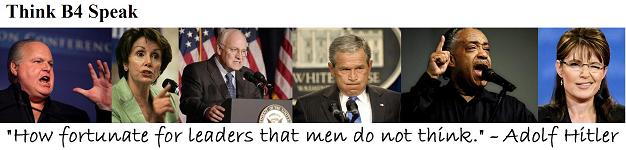
It is no surprise that a value-based decision process delivered us George W. Bush, arguably the most incompetent president in US history. Value-voting also nearly brought us within a heartbeat of President Sarah Palin (phew!). Call me crazy, but could we perhaps vote people into office based on their competence, being the best and brightest our country can produce, rather than if they are the kind of person we’d like to have a beer with?
As we are now staring down the barrel of the current global recession (maybe depression), wouldn’t it be great if our elected leaders who we are relying on were actually our country’s best and brightest? “Value voters” are so focused on their representatives matching their values, they seem to not mind (perhaps prefer?) an equivalent match in terms of their rudimentary grasp of economics, history, foreign policy, etc. Now that’s representation! I do not have a degree in history, or a PhD in economics. But I would like my government leaders to have such relevant expertise. Our elected leaders have immense responsibility and power. That being the case, I WANT them to be intellectually superior to me. We don't send children or the elderly to war, because they are incapable of being soldiers. So why do we send incapable representatives to Washington?
That said, I will empathetically speculate that many people vote on values because of the potentially overwhelming spectrum and complexity of politics (in part due to the self-contradicting Republican and Democrat platforms). Therefore, value-voters choose one issue to focus on. But I’m going to stop my sympathy there. If you are a person who can’t manage to educate yourself even a little beyond one myopic issue, perhaps you should reconsider if you should be casting a vote at all.
Saturday, May 2, 2009

Value-based Government
Somewhere along the way, many people got the idea in their head that democracy was about a values popularity contest (organized religion is the prime suspect for this misguided concept). The “winning” value system could then be subjected upon the entire populace, including upon those who disagree. Let me first admit that such a form of democracy is possible, if a democracy chooses to function that way. But that certainly isn’t the spirit in which American democracy was founded, by a people fleeing oppression and seeking individual liberty.
That said, here is why value-based government is a very bad idea… ready…? VALUES ARE NOT UNIVERSAL. Morality (another word for values) is subjective. What is an immoral activity to some, is not immoral to others. With that being the case, and since the US Constitution guarantees equal protection to all, we cannot adopt a subjective moral code which favors one citizen’s values over another.
This is where many people get lost, thinking that I am advocating a lawless anarchy. That is not the case. Borrowing from Libertarian principles, a well-structured, stable, and lawful society can be constructed around the “non-aggression principle”. The basic concept is that the purpose of government (and its laws) are to protect individuals from the aggressive harmful acts of others. I will refrain from an in-depth explanation at this point, but basically, you are entitled to any action which does threaten to cause unwanted direct harm on anyone else. Example: Drink alcohol or smoke marijuana – OK. Drink alcohol or smoke marijuana, and then drive a car under the influence – not OK. Example: Bob has consensual sex with Steve – OK. Bob rapes Steve – not OK. Pretty straight forward, right?
Granted there are more complex shades of gray to address, but again, I am not going to give a Libertarian dissertation here (research for yourself). I simply want to open minds to dispelling the misconception that we need values/morality to serve as a backbone for a lawful and constructive society. We do not. We simply need protection from the harmful aggression of others. Meanwhile, is their still a place for morality? Absolutely, but not in the form of government. Morality should be in the domain of community groups, churches, charities, etc. Such organizations can promote their moral beliefs without trying to have them dictated through government, which again, IS UNCONSTITUTIONAL.
That said, here is why value-based government is a very bad idea… ready…? VALUES ARE NOT UNIVERSAL. Morality (another word for values) is subjective. What is an immoral activity to some, is not immoral to others. With that being the case, and since the US Constitution guarantees equal protection to all, we cannot adopt a subjective moral code which favors one citizen’s values over another.
This is where many people get lost, thinking that I am advocating a lawless anarchy. That is not the case. Borrowing from Libertarian principles, a well-structured, stable, and lawful society can be constructed around the “non-aggression principle”. The basic concept is that the purpose of government (and its laws) are to protect individuals from the aggressive harmful acts of others. I will refrain from an in-depth explanation at this point, but basically, you are entitled to any action which does threaten to cause unwanted direct harm on anyone else. Example: Drink alcohol or smoke marijuana – OK. Drink alcohol or smoke marijuana, and then drive a car under the influence – not OK. Example: Bob has consensual sex with Steve – OK. Bob rapes Steve – not OK. Pretty straight forward, right?
Granted there are more complex shades of gray to address, but again, I am not going to give a Libertarian dissertation here (research for yourself). I simply want to open minds to dispelling the misconception that we need values/morality to serve as a backbone for a lawful and constructive society. We do not. We simply need protection from the harmful aggression of others. Meanwhile, is their still a place for morality? Absolutely, but not in the form of government. Morality should be in the domain of community groups, churches, charities, etc. Such organizations can promote their moral beliefs without trying to have them dictated through government, which again, IS UNCONSTITUTIONAL.
Sunday, April 26, 2009
Moral Welfare: Brought to you by Republicans
Republicans hate welfare, right? They don't want the income of hard working citizens to be overly taxed merely to be given away to lazy citizens. Frankly, I tend to agree. In economic terms, when a government is too parental, or overly regulatory, it weakens the economy by stifling natural competition. Republicans prefer free markets, with the general belief that free competition will support the advancement of stronger ideas, products, businesses, etc. The weak must be forced to adapt or be allowed to wither. I support the contention that this economic Darwinism favored by Republicans (how ironic considering the "religious right") produces a stronger economy, society, and country.
Republican's scorn for the Democrat-born ineptitude is humorously portrayed by the video clip called "Democrats on Escalator". It is quite funny, and the point is well made, that big-government weakens us by making us less self-reliant. When I was a teenager, I dislocated my knee skiing, and had to wear a full leg cast for a couple months. When the cast finally came off, I hopped off the doctor's table and nearly collapsed, because I was completely unprepared for how much two months of cast and crutches had weakened my entire right leg. This is the danger of Interventionist big government. It is a crutch which weakens us as individuals, and as a whole society.
So far, Republicans are cheering me on in this post. Well not so fast, if you are a typical value-touting Republican, I'm about to pull the rug out from under you. If you agree that big government weakens our country, and that free markets are the best way to ensure advancement of the strongest, then where does that faith go in terms of values and morality? Why do you desire a government which controls and dictates morality? This is the "values" equivalent of food stamps. It is moral welfare. If financial welfare weakens our economy, wouldn't the same principles conclude that moral welfare weakens the morality of our society. Certainly it must. Just as the Democrats were "stuck" on the escalator, unable to conceive of climbing the stairs, government controlled morality leaves us less able to conceive and consider moral issues without the use of a "crutch", such as the Bible, which is by no means a capable comprehensive resource for running a country.
Republicans, wake up and smell your hypocrisy.
- HeadLevel
Republican's scorn for the Democrat-born ineptitude is humorously portrayed by the video clip called "Democrats on Escalator". It is quite funny, and the point is well made, that big-government weakens us by making us less self-reliant. When I was a teenager, I dislocated my knee skiing, and had to wear a full leg cast for a couple months. When the cast finally came off, I hopped off the doctor's table and nearly collapsed, because I was completely unprepared for how much two months of cast and crutches had weakened my entire right leg. This is the danger of Interventionist big government. It is a crutch which weakens us as individuals, and as a whole society.
So far, Republicans are cheering me on in this post. Well not so fast, if you are a typical value-touting Republican, I'm about to pull the rug out from under you. If you agree that big government weakens our country, and that free markets are the best way to ensure advancement of the strongest, then where does that faith go in terms of values and morality? Why do you desire a government which controls and dictates morality? This is the "values" equivalent of food stamps. It is moral welfare. If financial welfare weakens our economy, wouldn't the same principles conclude that moral welfare weakens the morality of our society. Certainly it must. Just as the Democrats were "stuck" on the escalator, unable to conceive of climbing the stairs, government controlled morality leaves us less able to conceive and consider moral issues without the use of a "crutch", such as the Bible, which is by no means a capable comprehensive resource for running a country.
Republicans, wake up and smell your hypocrisy.
- HeadLevel
Monday, April 20, 2009
Dear Republicans: You danced with the devil and got dizzy.
This is an oversimplification of history, but at some point the collective conscious of your Republican party must have thought “Man, there sure are a lot of Christians in this country. How can we appeal to them and get all their votes?” Unfortunately, that collective conscious apparently failed to ask itself if appealing to Christian values might undermine what your party stands for. Well, it did undermine it, that is, if it is agreed that the Republican party stood for “conservative” (Minimalist) small government. Undeniably, incorporating the restrictive values of Christianity into government form is contrary to the notion of keeping government small (see “Give Me Liberty, or Give Me Welfare”). Are you starting to see why your party can’t seem to find its’ identity?
Republicans, you are blowing it big time. Technology is increasing the ease and speed of communication, and communication inherently increases tolerance of diversity. This would be playing to your strengths, if you had not abandoned true conservatism, which does not dictate values. Instead, by playing the “religion card” (dancing with the devil), you are swimming against the increasingly tolerant current of the future. Meanwhile, you have left the door wide open to the Libertarians, who may occupy the fertile political platform you turned away from.
Republicans, you are blowing it big time. Technology is increasing the ease and speed of communication, and communication inherently increases tolerance of diversity. This would be playing to your strengths, if you had not abandoned true conservatism, which does not dictate values. Instead, by playing the “religion card” (dancing with the devil), you are swimming against the increasingly tolerant current of the future. Meanwhile, you have left the door wide open to the Libertarians, who may occupy the fertile political platform you turned away from.
Dear Libertarians: Keep it real
First, my apologies for the lame opening contemporary catch phrase. You potentially have a very bright future in front of you, with the opportunity to displace the misguided Republican party. The challenge before you is to appeal to the masses in a relatively simple (but accurate) way that they can grasp and not be fearful of. Fear is a relevant emotion for you to be mindful of. When the average person here’s the fundamentals of Libertarianism, the word that comes to their mind is “anarchy”. You need to build a marketing campaign around the non-aggression principle, showing people how it is a reliable basis for healthy society.
Meanwhile, you need to lighten up not be so dramatic about how microscopic the government should be. Although I personally do not formerly affiliate with any party, I am most favorable to the Libertarian platform. That said, even I think you are a little unrealistic at times for how little government involvement you prescribe. We do need government to intervene in whatever places we cannot rely on private markets to regulate themselves (like global warming, if it’s real). You should focus on navigating that gray area in very practical (keep it real) terms, and lay a path for gradual reduction of government, rather than black and white extremes.
Meanwhile, you need to lighten up not be so dramatic about how microscopic the government should be. Although I personally do not formerly affiliate with any party, I am most favorable to the Libertarian platform. That said, even I think you are a little unrealistic at times for how little government involvement you prescribe. We do need government to intervene in whatever places we cannot rely on private markets to regulate themselves (like global warming, if it’s real). You should focus on navigating that gray area in very practical (keep it real) terms, and lay a path for gradual reduction of government, rather than black and white extremes.
Dear Democrats: Your heart is in the right place, but…
…you can’t have it both ways. I applaud your tolerance of diverse lifestyles, choices, etc. However, when people abuse that liberty and make irresponsible choices, you are too quick to bail them out. But if you insist on government that acts as the parent of our society, then you must be more restrictive of liberties to keep your “children” out of harm’s way.
Government should help those who cannot help themselves. However, by granting your citizens high levels of personal freedoms, but relatively low levels of personal accountability (see “Give Me Liberty, or Give Me Welfare”), you create a society in which government encourages those who choose not to help themselves, despite being able (i.e. people who are content to live on welfare). Hence the rightful objection of the hard-working wealthy who feel they are taxed to support the lazy. I personally do not endorse such a highly-Interventionist government model, but I would respect your position if it were more consistent with the “liberty-responsibility principle”.
Government should help those who cannot help themselves. However, by granting your citizens high levels of personal freedoms, but relatively low levels of personal accountability (see “Give Me Liberty, or Give Me Welfare”), you create a society in which government encourages those who choose not to help themselves, despite being able (i.e. people who are content to live on welfare). Hence the rightful objection of the hard-working wealthy who feel they are taxed to support the lazy. I personally do not endorse such a highly-Interventionist government model, but I would respect your position if it were more consistent with the “liberty-responsibility principle”.
Friday, April 17, 2009
Meaning of Think B4 Speak
We live in a time when people seem to be more concerned about the volume of their opinion than the quality of their opinion.
Years ago I started to get annoyed with local news broadcasts. Particularly when they would do "public opion" segments, taking camera crews on the streets to get opinions of random people on various topics. My annoyance was that with a microphone shoved in their face, people would just throw around opinions that they had probably given very little thought to, not to mention if they were even qualified to give any reasonable opinion on the topic. Their ignorance gets broadcast to infect the masses.
Likewise the media publishes public opinion polls on topics like:
- Should Iran be allowed to develop a nuclear program?
- Do you agree with the President's ecomonic program?
- Should the US remain active in the United Nations?
I wish these same polls would offer a response of "I don't think I am qualified to comment on that subject".
I don't mean to sound elitist. I am only criticizing lazy or devisive opinions. Of course, ideas can also be useless if they are too elaborate. I try to keep my articles concise, yet thorough. "Think B4 Speak" is simply an appeal for people to at least make a reasonable attempt to consider an issue before voicing an opinion on it. Likewise, let's not adopt political propoganda without objective consideration. Too many people think that it is a necessity to have and voice an opinion on all topics. I would like to point out that "I don't know" is a perfectly acceptable and respectable position to take, until you've had some time to offer a thoughtful opinion. We all enjoy freedeom of speech. Let's also enjoy the occassional freedom to not speak, until we think.
Years ago I started to get annoyed with local news broadcasts. Particularly when they would do "public opion" segments, taking camera crews on the streets to get opinions of random people on various topics. My annoyance was that with a microphone shoved in their face, people would just throw around opinions that they had probably given very little thought to, not to mention if they were even qualified to give any reasonable opinion on the topic. Their ignorance gets broadcast to infect the masses.
Likewise the media publishes public opinion polls on topics like:
- Should Iran be allowed to develop a nuclear program?
- Do you agree with the President's ecomonic program?
- Should the US remain active in the United Nations?
I wish these same polls would offer a response of "I don't think I am qualified to comment on that subject".
I don't mean to sound elitist. I am only criticizing lazy or devisive opinions. Of course, ideas can also be useless if they are too elaborate. I try to keep my articles concise, yet thorough. "Think B4 Speak" is simply an appeal for people to at least make a reasonable attempt to consider an issue before voicing an opinion on it. Likewise, let's not adopt political propoganda without objective consideration. Too many people think that it is a necessity to have and voice an opinion on all topics. I would like to point out that "I don't know" is a perfectly acceptable and respectable position to take, until you've had some time to offer a thoughtful opinion. We all enjoy freedeom of speech. Let's also enjoy the occassional freedom to not speak, until we think.
Thursday, April 16, 2009
Labels & Definitions: A Few Words... on Words
I've given quite a bit of thought to our country's politics in recent years. Through substantial reflection, I came to feel that I had materialized a handful of well developed perspectives. I decided to take the next step by articulating my thoughts in writing for the public forum. In doing so, I realized a tricky communication barrier was in front of me. My thoughts in the forum of my own head were based on a vocabulary that was universal to the entire audience of my head: Me. However, I know that certain political labels are far from universal in the public forum -- most notably, the widely used terms of Conservative and Liberal.
For those who may not be aware, those two terms have actually completely reversed in definition over the past 200 years or so (really, research their historical definitions). And from what I can tell, the contemporary definitions are far from agreed. In my head, Conservative is most simply meant to refer to small government, while Liberal is relatively larger government. Although most would agree with that, I point to the contemporary label "social conservatism", which seems to vaguely refer to "traditional" and/or religious values. "Social conservatives" (it hurts me to even write the horribly mislabelled term) want such values to be intertwined with our government and administerd to the populous. However such activity is undeniably an increase in the size and scope of government. So in other words, "social conservatism" is in fact the opposite of small government Conservatism.
So back to my dilemma. Do I first take on the task of recalibrating the definitions of Conservative and Liberal, at the risk to that distracting and somewhat pointless debate? Or do I leave them behind and adopt replacement labels, despite my reluctance to add more label clutter to the political landscape? Considering the roller coaster history of the these two existing labels, I am opting leave them and their baggage behind, and instead adopt my own new labels for public use. Learning from the lesson of Conservative and Liberal causing their own definition problems by being somewhat vague and arbitrary labels, I have reflected on adopting more clear and self-defining labels for what I consider to be the two poles of government role:
Minimalism: A government which is small/minimal is size.
Interventionism: A government which seeks to play a more active role.
So, I bid farewell to Conservative and Liberal, and say hello to Minimalist and Interventionist!
For those who may not be aware, those two terms have actually completely reversed in definition over the past 200 years or so (really, research their historical definitions). And from what I can tell, the contemporary definitions are far from agreed. In my head, Conservative is most simply meant to refer to small government, while Liberal is relatively larger government. Although most would agree with that, I point to the contemporary label "social conservatism", which seems to vaguely refer to "traditional" and/or religious values. "Social conservatives" (it hurts me to even write the horribly mislabelled term) want such values to be intertwined with our government and administerd to the populous. However such activity is undeniably an increase in the size and scope of government. So in other words, "social conservatism" is in fact the opposite of small government Conservatism.
So back to my dilemma. Do I first take on the task of recalibrating the definitions of Conservative and Liberal, at the risk to that distracting and somewhat pointless debate? Or do I leave them behind and adopt replacement labels, despite my reluctance to add more label clutter to the political landscape? Considering the roller coaster history of the these two existing labels, I am opting leave them and their baggage behind, and instead adopt my own new labels for public use. Learning from the lesson of Conservative and Liberal causing their own definition problems by being somewhat vague and arbitrary labels, I have reflected on adopting more clear and self-defining labels for what I consider to be the two poles of government role:
Minimalism: A government which is small/minimal is size.
Interventionism: A government which seeks to play a more active role.
So, I bid farewell to Conservative and Liberal, and say hello to Minimalist and Interventionist!
Wednesday, April 15, 2009
Give Me Liberty, Or Give Me Welfare!
In modifying Patrick Henry’s famous quote from his 1775 speech, I do not mean to equate welfare with death. My intent with the title and content of this article is to illustrate that we as adults, as citizens, as a society, must choose if we desire a country which values personal liberties and the responsibilities which come with it, OR if we desire a country with a highly parental care-taking government and the sacrifices to personal freedoms which must come with that. Most importantly, it must be recognized that neither of our leading political parties (Republican and Democrat) offer us a sensible and sustainable choice between those options. We must demand political representation which offers us that clear choice, then allow the nation to democratically choose the preferred form of government and resulting society.
Allow me to start by illustrating a simple reality. As fundamental as the law of gravity is to physics, or as supply and demand are to economics, there is an inherent relationship between liberty and responsibility in the course of human society. The fact that our political leadership ignores this fundamental is akin to a return to believing that the earth is flat. Likewise as the Soviet Union ignored basic economic principles, their economy collapsed. I fear a similar collapse of our previously inspirational American society.
Now to explain the natural relationship between liberty and responsibility. The more liberty one desires, the more responsibility one must accept for one’s own well being. If you enjoy freedom of choice, you must accept responsibility for the consequences of your actions. Conversely, the less responsibility a person is willing to accept, the less liberty that person should feel entitled to. One could say this relationship between liberty and responsibility was core to Patrick Henry and his American independence-seeking peers. Their mission for independence (liberty) came only with the prerequisite of a willingness to accept self-responsibility, forgoing the support of the British parent nation.
Illustrating this on a practical level, imagine your teenage son or daughter asks to borrow the car to go to a friend’s birthday party. Surely your consideration will include the history of responsible behavior which that child has or has not previously displayed. In other words, if the child has consistently demonstrated high responsibility (good grades, maintains a job, respects curfew, etc), you are more willing to extend greater liberty, than if the child consistently displays lack of such responsible behavior.
Having established the “liberty-responsibility principle”, let’s now examine how our two leading political parties ignore that fundamental principle, as though ignoring the law of gravity. First, it must be exposed that contrary to contemporary labels, the Republican party does not represent a consistent “small government” (Minimalist) platform, nor does the Democratic party represent a consistent “big government” (Interventionist) platform. They both represent a contradicting mix of both platforms. Those contradictions inevitably produce a dysfunctional society.
The Democratic party allows for a relatively large government in economic terms, in the form of a care-taking parental government (welfare, health care, higher market regulations, etc). This is consistent with the modern label of big government. However, on social matters, the party is actually quite Minimalist (i.e. small, non-intervening government) in terms of tolerance of diverse values and lifestyles. In other words, the party grants high levels of individual liberty, but demands relatively low levels of personal responsibility. In the Democrats’ model society, a person can be irresponsible with their liberty, but nonetheless the government will be there to bail them out like a spoiled child. Do we want a society which behaves like spoiled children?
In an opposite form of equally irrational society, the Republican party wishes for a small government in economic terms. However it meanwhile seeks for government to play a heavy role in social matters, or “values” (religion, defining marriage, various lifestyle prohibitions, etc). This big-brother role is undeniably a form of big-government Interventionism, and collectively contradicts the liberty-responsibility principle. The Republican party expects high responsibility from the people economically, but does not grant a corresponding level of liberty. The failure of this societal model is that in dictating what people think and believe (without the liberty to think and decide for themselves), the government has left these passive people ill-equipped to be self-responsible, despite the government's expectation for personal responsibility. For example, imagine if you raised a child in a manner which dictated their every thought and action, without ever engaging their personal reasoning with questions such as “Well Billy, what do think is the right is thing to do?” Would that sheltered child grow up to be a capable self-responsible adult? Of course not. Nevertheless, the Republican party wants to dictate our thoughts and “values”, but irrationally still expects a highly self-responsible society.
In closing, consider that America was colonized by immigrants who left Britain is search of personal liberty. As liberty naturally goes hand in hand with responsibility, it was practically inevitable that an independent nation would result. So in saying “Give me liberty, or give me welfare”, I am stating that we as a society, we as a country, must be allowed to choose between truly Minimalist or truly Interventionist options. That is not to imply that such a choice is between black and white. It is a spectrum connected by many shades of gray. But we must recognize that the two party options presented to us do not offer coherent options of consistent Interventionism or consistent Minimalism. Their mutual inconsistency both lead to a dysfunctional society which ignores the liberty-responsibility principle. We must recognize these options as false, and demand better representation. Then through educated voting, we let the true voice our country be heard.
- HeadLevel
Allow me to start by illustrating a simple reality. As fundamental as the law of gravity is to physics, or as supply and demand are to economics, there is an inherent relationship between liberty and responsibility in the course of human society. The fact that our political leadership ignores this fundamental is akin to a return to believing that the earth is flat. Likewise as the Soviet Union ignored basic economic principles, their economy collapsed. I fear a similar collapse of our previously inspirational American society.
Now to explain the natural relationship between liberty and responsibility. The more liberty one desires, the more responsibility one must accept for one’s own well being. If you enjoy freedom of choice, you must accept responsibility for the consequences of your actions. Conversely, the less responsibility a person is willing to accept, the less liberty that person should feel entitled to. One could say this relationship between liberty and responsibility was core to Patrick Henry and his American independence-seeking peers. Their mission for independence (liberty) came only with the prerequisite of a willingness to accept self-responsibility, forgoing the support of the British parent nation.
Illustrating this on a practical level, imagine your teenage son or daughter asks to borrow the car to go to a friend’s birthday party. Surely your consideration will include the history of responsible behavior which that child has or has not previously displayed. In other words, if the child has consistently demonstrated high responsibility (good grades, maintains a job, respects curfew, etc), you are more willing to extend greater liberty, than if the child consistently displays lack of such responsible behavior.
Having established the “liberty-responsibility principle”, let’s now examine how our two leading political parties ignore that fundamental principle, as though ignoring the law of gravity. First, it must be exposed that contrary to contemporary labels, the Republican party does not represent a consistent “small government” (Minimalist) platform, nor does the Democratic party represent a consistent “big government” (Interventionist) platform. They both represent a contradicting mix of both platforms. Those contradictions inevitably produce a dysfunctional society.
The Democratic party allows for a relatively large government in economic terms, in the form of a care-taking parental government (welfare, health care, higher market regulations, etc). This is consistent with the modern label of big government. However, on social matters, the party is actually quite Minimalist (i.e. small, non-intervening government) in terms of tolerance of diverse values and lifestyles. In other words, the party grants high levels of individual liberty, but demands relatively low levels of personal responsibility. In the Democrats’ model society, a person can be irresponsible with their liberty, but nonetheless the government will be there to bail them out like a spoiled child. Do we want a society which behaves like spoiled children?
In an opposite form of equally irrational society, the Republican party wishes for a small government in economic terms. However it meanwhile seeks for government to play a heavy role in social matters, or “values” (religion, defining marriage, various lifestyle prohibitions, etc). This big-brother role is undeniably a form of big-government Interventionism, and collectively contradicts the liberty-responsibility principle. The Republican party expects high responsibility from the people economically, but does not grant a corresponding level of liberty. The failure of this societal model is that in dictating what people think and believe (without the liberty to think and decide for themselves), the government has left these passive people ill-equipped to be self-responsible, despite the government's expectation for personal responsibility. For example, imagine if you raised a child in a manner which dictated their every thought and action, without ever engaging their personal reasoning with questions such as “Well Billy, what do think is the right is thing to do?” Would that sheltered child grow up to be a capable self-responsible adult? Of course not. Nevertheless, the Republican party wants to dictate our thoughts and “values”, but irrationally still expects a highly self-responsible society.
In closing, consider that America was colonized by immigrants who left Britain is search of personal liberty. As liberty naturally goes hand in hand with responsibility, it was practically inevitable that an independent nation would result. So in saying “Give me liberty, or give me welfare”, I am stating that we as a society, we as a country, must be allowed to choose between truly Minimalist or truly Interventionist options. That is not to imply that such a choice is between black and white. It is a spectrum connected by many shades of gray. But we must recognize that the two party options presented to us do not offer coherent options of consistent Interventionism or consistent Minimalism. Their mutual inconsistency both lead to a dysfunctional society which ignores the liberty-responsibility principle. We must recognize these options as false, and demand better representation. Then through educated voting, we let the true voice our country be heard.
- HeadLevel
Opening Post
Sometime not long after finishing college, I began to "awaken" politically. I'm not saying I became intensely involved, I just began considering my beliefs and where they fit into the established landscape. I gradually realized that my personal political "platform" did not fit the conventional molds, and I tended to describe myself as a mix of various Republican, Democrat, Conservative, and Liberal identities. In other words, I was strange...
I continued to digest this over the years, then eventually came to realize it wasn't I who was strangely calibrated, it was our political landscape which had become twisted and irrational.
My core purpose is to articulate that revelation in a manner which others can follow and potentially get on board with, in a much more direct route than my years of contemplation. I aim to convey this in relatively simple (not simplistic) yet intelligent (not elitist) terms which can be passed on to others. In other words, I do not want to be a propoganda-spewing Rush Limbaugh who deals in irresponsibly over-simplified mantras, nor an egghead who can only be appreciated by academics and political professionals. I aim for a middle ground which can be grasped by any citizen who is willing to put forth an open mind and modest amount of mental effort -- which I hope any voting citizen would.
Your thoughtful comments in agreement or dissent are more than welcome.
Sincerely,
HeadLevel
I continued to digest this over the years, then eventually came to realize it wasn't I who was strangely calibrated, it was our political landscape which had become twisted and irrational.
My core purpose is to articulate that revelation in a manner which others can follow and potentially get on board with, in a much more direct route than my years of contemplation. I aim to convey this in relatively simple (not simplistic) yet intelligent (not elitist) terms which can be passed on to others. In other words, I do not want to be a propoganda-spewing Rush Limbaugh who deals in irresponsibly over-simplified mantras, nor an egghead who can only be appreciated by academics and political professionals. I aim for a middle ground which can be grasped by any citizen who is willing to put forth an open mind and modest amount of mental effort -- which I hope any voting citizen would.
Your thoughtful comments in agreement or dissent are more than welcome.
Sincerely,
HeadLevel
Subscribe to:
Comments (Atom)